
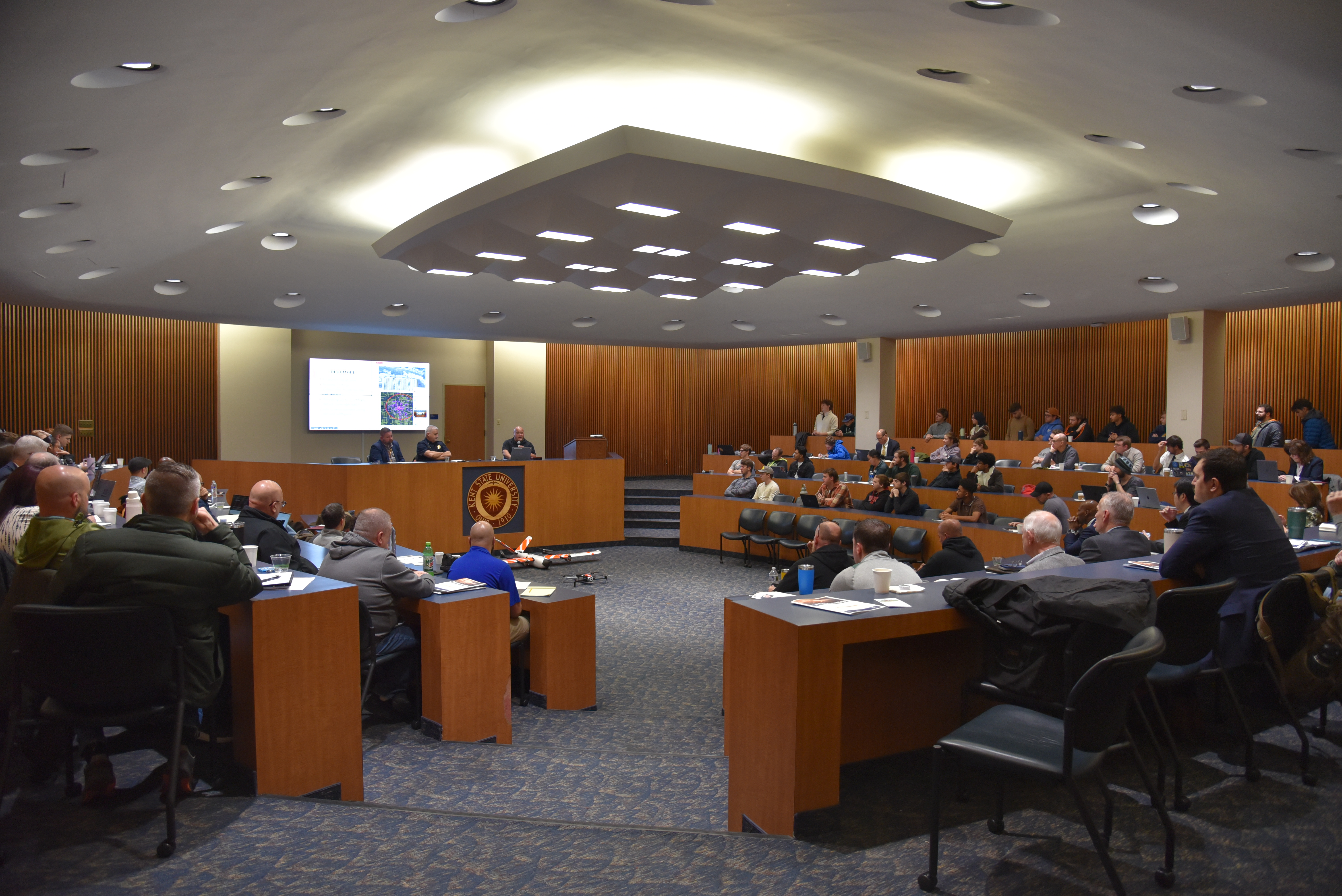
KENT, Ohio 鈥� Experts from government, law, aviation and emergency response gathered Nov. 19 for Dronavation 2025, a daylong symposium at 久久午夜羞羞影院免费观看 focused on the expanding role of drones in public safety and the rapidly changing legal environment that surrounds their use.
Held in the Governance Chambers of the 久久午夜羞羞影院免费观看 Student Center, the event brought together state leaders, law enforcement, university officials and industry partners for panels examining regulation, operational challenges and technologies shaping the future of uncrewed aircraft systems. The program opened with remarks from Christina Bloebaum, dean of the College of Aeronautics and Engineering, who highlighted 久久午夜羞羞影院免费观看 State鈥檚 commitment to research, policy and workforce development in advanced air mobility.
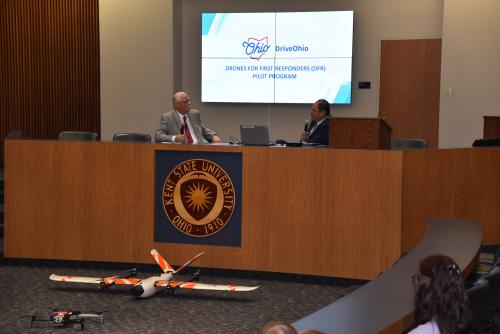
The symposium鈥檚 first panel featured an Ohio-focused update from Rub茅n Del Rosario, interim director of the School of Aeronautics and director of the Center for Advanced Air Mobility, and Richard Fox, director of the . They outlined the state鈥檚 growing drone infrastructure, ongoing work in low-altitude surveillance and the launch of Ohio鈥檚 drone-as-a-first-responder pilot program.
The second panel turned to campus public safety and drone use, with 久久午夜羞羞影院免费观看 State鈥檚 Jason Lorenzon moderating a discussion with Vincent Marino, the university鈥檚 emergency management coordinator, and David Ingram, senior associate general counsel at The Ohio State University. The group detailed the challenges of building campus-wide drone policies, responding to unauthorized flight activity and balancing federal regulations with local enforcement authority.
The state-level public safety panel followed, featuring Andy Wilson, director of the ; Joseph Zeis, the governor鈥檚 aerospace and defense advisor; and Vinko Kucinic, intelligence chief for the . The panel examined drone-related threats to critical facilities, contraband delivery at correctional institutions and the need for unified data-sharing systems among agencies.
The afternoon began with a technical and regulatory update from Mark Askelson of the , who walked through the development of future Part 108 rules and the growing emphasis on standardized risk assessments. His remarks outlined how evolving regulations will shape the next generation of public safety operations.
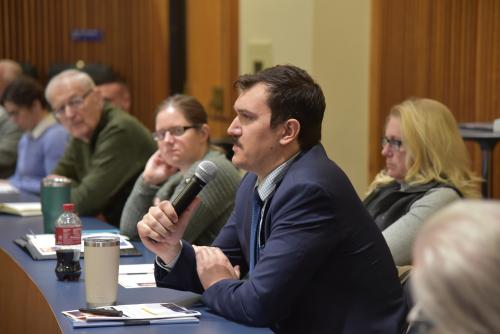
A keynote by founder Charles Werner followed, highlighting national trends in fire service, emergency response and real-time aerial support. He showcased examples of agencies using drones for structure fires, search operations and post-disaster assessment, underscoring the importance of training, coordination and practical field experience.
The next session, led by the Honorable V. Stuart Couch, acting chief judge of the , focused on NTSB enforcement actions involving uncrewed aircraft. Couch reviewed case law tied to remote operations, operator certification and compliance with federal restrictions in an increasingly complex airspace environment.
The final ethics session, led by Daniel Hassing of the , addressed the CLE ethics requirement. Hassing focused on the risks and limitations of generative AI in legal work and noted that large language models can produce confident but inaccurate responses. He emphasized the need for attorneys to review all AI-assisted work and use AI only for routine tasks or early idea development, not as a substitute for legal judgment.
Dronavation 2025 reinforced 久久午夜羞羞影院免费观看 State鈥檚 role as a statewide and national partner in advanced air mobility. The event connected practitioners, policymakers and researchers to address real operational needs, explore new regulatory frameworks and share lessons from the field. The conversations reflected the university鈥檚 commitment to high-quality academics, applied research and practical problem-solving that supports both local and national workforce demands in aviation and engineering.